
In Phoenix, the sewer line under your yard is almost certainly yours to maintain, which makes it worth understanding before it fails. The City of Phoenix says homeowners are responsible for cleaning and maintaining the sewer line that runs from the house to the connection with the city sewer main in the street or alley. This guide explains what sewer pipe relining is, what tends to damage Phoenix sewer lines, when relining is the right repair, and when it is not.
Who Owns the Sewer Line in Phoenix
The City maintains the main, and you maintain everything between the main and your house. The City of Phoenix states that under City Code Section 28-5 it will only repair broken service lines within the public right of way. For most homes, that means a cracked, root-filled, or deteriorating line is the owner's repair and the owner's expense.
Knowing that changes how you should think about a camera inspection. A line you own is a line you can inspect, and an inspection is the only way to learn its material, its condition, and whether lining or replacement fits. Our sewer camera inspection page explains what the process shows, and an inspection is free with every repair.
If sewage is coming up through a manhole in the street, that is the City's side. The City asks residents to call 602-262-6691 on weekdays from 6 AM to 2:30 PM, and 602-261-8000 after hours, on weekends, and on holidays. A backup inside your home is a different situation, and it usually starts in your own line.
What Sewer Pipe Relining Is
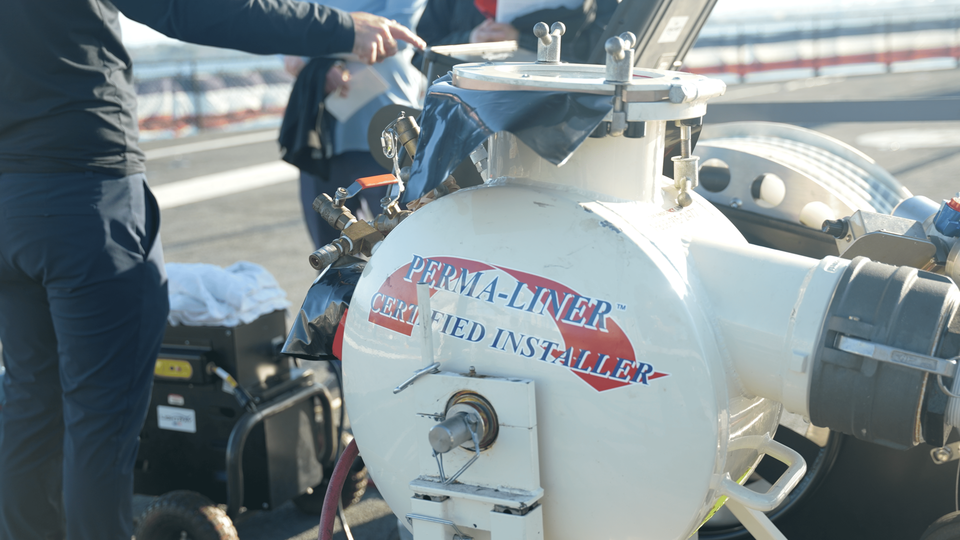
Relining puts a new pipe surface inside the old pipe. Instead of removing the damaged pipe, a liner is placed inside it and set so that it seals against the existing walls. The old pipe stays in the ground, and its inside gets a new, smooth surface that closes cracks and leaking joints.
The repair is made through small access points instead of a long trench. Technicians reach the pipe at a cleanout or a limited excavation, work the liner through the line, and finish without opening the yard along the entire run. That is why relining is called a trenchless repair. It does not promise that no digging is ever needed, and anyone who says so should explain which access points their plan requires.
What Damages Phoenix Sewer Lines
The City of Phoenix names two primary causes of sewer backups: grease and roots. Grease cools, hardens, and builds up into plugs. Roots are the problem relining is most often asked to solve.
Roots do not break healthy pipe, they find the openings in damaged pipe. According to the City, roots probe the sewer line looking for any opening, such as a crack or a poorly sealed joint, and once inside they form a ball that blocks the line. A liner seals those openings, which is why relining is a common repair for root intrusion in pipe that is otherwise intact.
Where you plant matters. The City advises not planting trees and shrubs close to your cleanouts or sewer service line. A lined pipe has no gaps for roots to enter, but large trees near any line are still worth watching.
Hard ground adds a second Phoenix factor. Caliche is a layer in which soil particles are cemented together by calcium carbonate, and it is common in southern Arizona soils. It makes digging slower and harder, which is one reason repairs that avoid opening the whole line are attractive in the Valley. We cover the local soil conditions in our guide to what Phoenix's soil does to your sewer lines.
Phoenix Hard Water and Why Cleaning Comes Before Lining
Phoenix water is very hard, and mineral buildup is part of what a camera inspection looks for. The City's 2025 water quality report lists total hardness in the distribution system at 172 to 302 parts per million, or 10 to 17.6 grains per gallon. The City notes that hard water can cause scaling in pipes and water heaters.
Many sewer problems turn out to be buildup, not pipe failure. Hardened mineral scale and deposits can narrow a line and mimic damage on a first look. Before recommending a repair, we may recommend descaling and hydrojetting to restore flow and see the pipe underneath. In many cases that changes the diagnosis, and if cleaning solves the problem, we stop there.
Lining also depends on a clean surface. A liner needs a properly prepared pipe to set against. Cleaning is part of getting a lining job right, not an add-on.
When Relining Works and When It Does Not
Relining is only for pipes that have a relatively sound structure and damage such as cracks. Typical examples include small cracks, leaking joints, and places where roots have found a way in. In those cases the old pipe still holds its shape, and a liner can restore a smooth, sealed interior.
Relining is not an option for a pipe that is structurally unsound. A liner needs the old pipe to serve as a stable host. A pipe that has collapsed, deformed badly, bulged, or separated needs a full replacement. We show a real example in our Orangeburg replacement case study, where the line was too far gone to line, and we explain the decision in pipe relining vs replacement.
Phoenix Homes, Pipe Ages, and Materials
Phoenix has a lot of mid-century housing, and that matters for pipe. In 1950 the City of Phoenix had 106,818 residents. By 1960 it had 439,170, and by 1970 it had 584,303. Homes from that boom are now many decades old, and the pipe under them was installed with whatever materials were in use at the time.
Different neighborhoods were built with different materials, and each fails in its own way. During camera inspections across the Valley, we commonly see Orangeburg, cast iron, clay, galvanized, and concrete sewer lines. On camera they can look similar, but they do not fail the same way, and which repair fits depends on what is in the ground.
| Pipe Material | How It Tends to Fail | What That Means for Repair |
|---|---|---|
| Orangeburg | Softens and loses its shape, sometimes bulging | Often a replacement candidate if it has deformed |
| Cast iron | Corrodes from the inside and builds up scale | Cleaning first, then lining if it is structurally sound |
| Clay | Joints separate or crack, and roots find their way in | Often a lining candidate when the pipe is intact |
| Galvanized | Corrodes and narrows over time | Depends on condition and size |
| Concrete | Cracks and deteriorates | Depends on how much of the pipe is still intact |
Age alone does not tell you what is wrong. Two homes built the same year can have very different pipe conditions. Our guide to Orangeburg pipe in Phoenix covers one material that turns up in mid-century homes.
The Relining Methods You Will Hear About
Phoenix Trenchless offers four lining and coating approaches, and they are not interchangeable. Each differs in how it is installed and cured, and in the pipe layouts it suits.
CIPP pipe lining is cured-in-place pipe. A resin-saturated liner is placed in the existing pipe and cured to form a new pipe inside the old one. You can read more on our CIPP pipe lining page.
UV-cured pipe repair uses ultraviolet light to harden the liner. The light cures the liner in place from inside the pipe. Our UV-cured pipe repair page explains where it fits.
Epoxy coating and lining applies an epoxy surface to the inside of the pipe. It is used to seal and protect the pipe interior. See the epoxy coating and lining page for details.
Pull-in-place pipe repair pulls the liner into the pipe. It is the approach to ask about when a line has bends or a complex configuration. Our pull-in-place pipe repair page covers it.
Which method fits depends on the pipe, not on a preference. The material, diameter, condition, and layout all matter, and a good contractor explains why a method was chosen for your line.
How a Relining Job Goes in Phoenix
It starts with a camera inspection. A sewer camera is run through the line so you and the technician can see the material, the damage, and the layout. If buildup is the main problem, cleaning comes first.
Locates and permits come before any digging. Arizona law requires anyone who plans to dig to contact Arizona 811 at least two full working days in advance so underground utilities can be marked. That applies to the access points for a lining job as well. The City of Phoenix code also includes a permit requirement for connections to public sewers, and Phoenix Trenchless handles required permits and inspections as part of the work.
The liner is installed and set, then the work is checked. The method used determines how the liner goes in and how it cures or hardens. A final camera pass confirms the lined pipe and its connections from the inside.
What Relining Does Not Change
A lined pipe is still the same route. The pipe stays where it is, so relining does not fix a pipe that is in the wrong place, sags into a low spot, or has separated so that the sections no longer line up. Those are the cases where replacement comes up, and our pipe bursting page covers one way to do it.
Relining does not change what goes down the drain. The City calls grease the most frequent cause of sewer problems, so keeping cooking grease and oil out of the drain still matters after a repair.
Questions to Ask Before You Agree to Any Repair in Phoenix
Ask to see the camera footage. If a repair is recommended, you should be able to see what the technician saw. If no inspection was done before a quote, that is worth questioning.
Ask why this method was chosen for your pipe. The answer should refer to the material, condition, and layout of your line, not a general preference.
Check the contractor's license. The Arizona Registrar of Contractors lets you look up a contractor's license before work starts.
Ask who handles permits and locates. These are required steps, and you should know who is responsible for them.
Ask about a second opinion if the recommendation surprises you. If someone tells you the only option is to dig up the whole yard, it is fair to want another look. We wrote about this in when to get a second opinion on a sewer repair quote in Phoenix.
Frequently Asked Questions
If the City maintains the sewer main, who pays when my line fails?
In most cases, you do. The City of Phoenix says homeowners are responsible for the line from the house to the connection with the city main, and that it will only repair broken service lines within the public right of way. A camera inspection shows where in your line the problem sits.
Can lining stop tree roots from coming back?
A liner seals the cracks and joints that roots use to get in, so it can stop roots from re-entering at those points. Roots still need to be cleared before lining, and large trees near the line are worth watching.
Does hard water damage sewer pipe?
Phoenix water is very hard, and the City notes it can cause scaling in pipes and water heaters. Mineral buildup can narrow a line and mimic damage, which is why we inspect and clean before recommending any repair.
How do I know if my pipe can be relined?
The existing pipe has to have a relatively sound structure. Cracks, leaking joints, and root entry are often good candidates, while a pipe that has collapsed, bulged, or separated needs replacement. A sewer camera inspection is how that is determined.
Does relining mean no digging at all?
Not always. Relining is done through access points, and some jobs need a small excavation to reach the pipe or make a connection. What it avoids is opening the full length of the line.
Talk to Phoenix Trenchless About Your Sewer Line
If you are not sure whether your pipe can be relined, start with a look inside it. A sewer camera inspection is free with every repair, standalone inspections are available, and free second opinions are offered on sewer repair quotes. Call (602) 600-6039 or book online.
