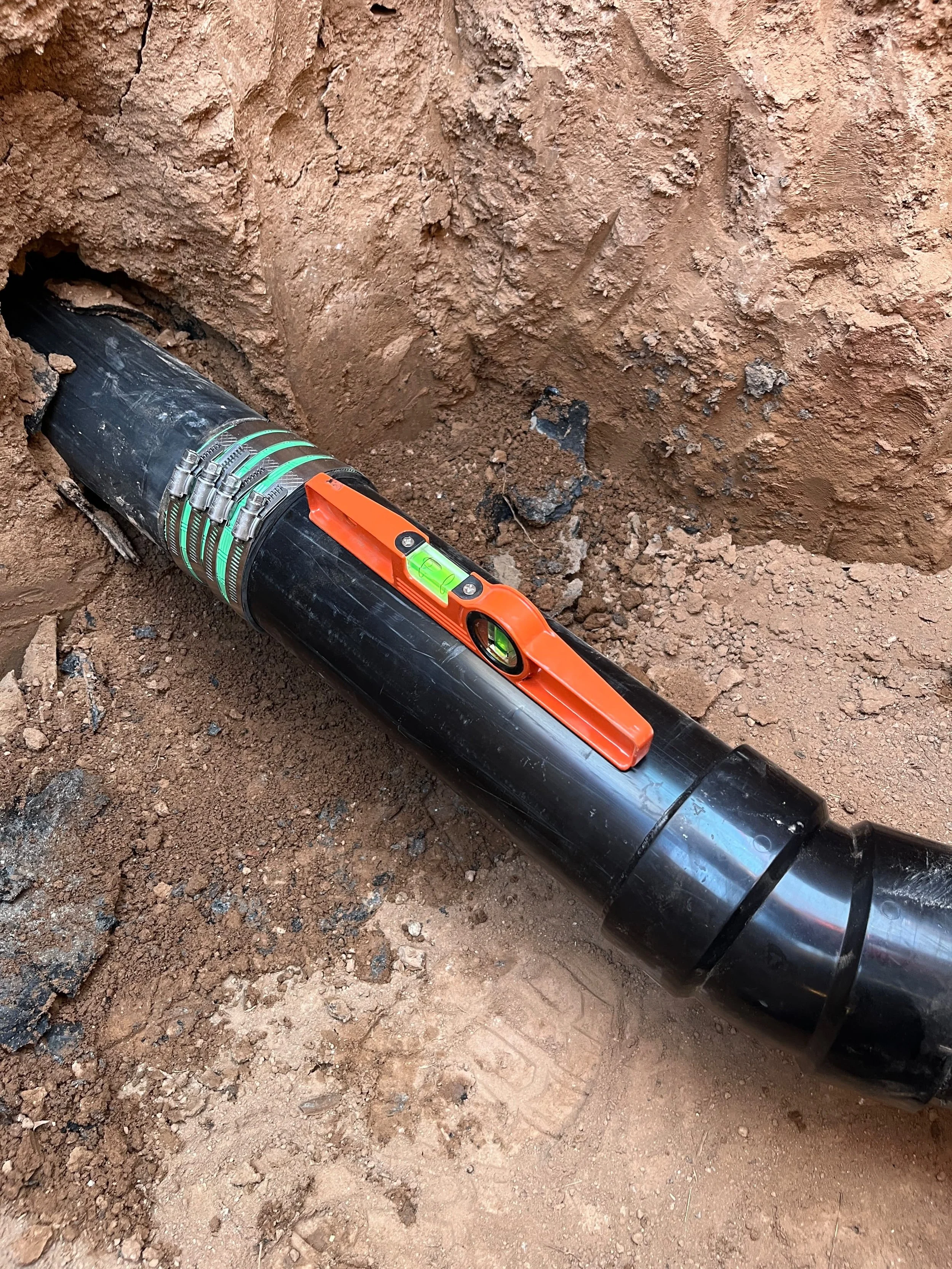
New HDPE pipe replaced old orangeburg in Phoenix
Some sewer lines show you they are failing long before they stop working. This one belonged to a home in Phoenix built in 1961. Its original sewer pipe was Orangeburg, and by the time we were called it had deteriorated and developed bulges. This case study walks through why the line needed a full replacement, what the job covered, how pipe bursting was used with minimal excavation, and what Phoenix owners of mid-century homes should know about who is responsible for a line like this.
The Home and the Era It Was Built In
A 1961 build date puts this home at the tail end of the biggest growth decade in Phoenix history. In 1950 the City of Phoenix had 106,818 residents. By 1960 it had 439,170. Housing went up fast across the Valley, and the sewer lines under those homes are now more than six decades old.
Different neighborhoods were built with different pipe materials, and each material fails differently. During camera inspections across the Valley, we commonly see Orangeburg, cast iron, clay, galvanized, and concrete sewer lines. Orangeburg is a fiber pipe held together with pitch, not a rigid plastic, clay, or cast iron pipe. We cover where it is found and why it fails in our guide to Orangeburg pipe in Phoenix.
The Condition of the Pipe
This line was deteriorating and had developed bulges. Many pipe materials fail by cracking. Orangeburg tends to fail by softening and losing its shape. A bulge is the visible sign of that: the wall has weakened and pushed out of round. A deformed section can restrict flow, catch waste and paper as it moves through, and keep getting worse.
A bulge also means the pipe is structurally unsound. The pipe is no longer doing the job it was installed to do, and that decides which repairs are possible.
Why Replacement, Not Lining
This line was structurally unsound, so it needed a full replacement. Pipe lining is only for pipes that have a relatively sound structure and damage such as cracks. A liner needs the old pipe to hold its shape, and Orangeburg that has deteriorated and bulged no longer does. Lining was not an option on this job. We explain how that decision is made in pipe relining vs replacement.
Pipe bursting replaces a failed line without trenching its entire length. That is the method used here. The old pipe is broken apart and a new pipe is pulled into the same path, with excavation only at the access points. You can read more about how it works on our pipe bursting page.
Whose Pipe Is It in Phoenix
For a home like this, the failing line is the owner's responsibility. The City of Phoenix says homeowners are responsible for cleaning and maintaining the sewer line that runs from the house to the connection with the city sewer main in the street or alley. The City also states that under City Code Section 28-5 it only repairs broken service lines within the public right of way.
That is why catching a failing line early matters. An owner who learns the line is deteriorating before it collapses has time to compare options and choose a planned repair, instead of making decisions during a backup.
The Scope of Work, in Plain English
The job replaced up to 50 feet of existing Orangeburg sewer line. The new pipe is HDPE, a durable, flexible plastic pipe, installed with approved fittings. Here is what the scope covered.
Two access points were excavated. Instead of opening a trench along the full run of pipe, the crew exposed the existing sewer line at two locations. Those two openings are what make the bursting method possible. This is minimal excavation, not a full dig.
The old pipe was replaced by bursting. With the line exposed, the old Orangeburg was broken apart and the new HDPE pipe was pulled into the same path behind the bursting tool. The new line follows the route of the old one, so the work does not need to chase a new path across the yard.
New cleanouts were installed. The scope included new bullhorn cleanouts. A cleanout gives a technician a point of access to the line for cleaning, maintenance, and camera inspection later.
All required connections were made to the existing sewer system. A new pipe only helps if it ties in properly at both ends.
The laundry drain was rebuilt. The existing laundry drain P-trap and standpipe were replaced with new ABS piping and fittings. It makes sense to replace these parts while the line is open instead of leaving older fittings attached to a brand new pipe.
Affected half-inch copper water lines were replaced where needed. When plumbing work happens in a tight area, nearby water lines sometimes have to be replaced to make the repair possible. On this job, the affected 1/2" copper lines were replaced as necessary to accommodate the sewer work.
The new piping was secured and supported, the excavation was backfilled and compacted, and the work area was cleaned up. Properly supported pipe stays in position, compacted backfill keeps the ground from settling over the repair, and plumbing-related debris was removed from the work area when the job was done.
How Pipe Bursting Works
Pipe bursting replaces a pipe by working along the path the old pipe already follows. A bursting head is pulled through the old line from one access point to the other. As it moves, it breaks the old pipe apart and pushes the fragments into the surrounding soil. The new pipe is attached behind the head and pulled into the space the old pipe left behind.
The result is a continuous new line in the same location. For a home like this one, that matters. The yard, landscaping, and hardscape along most of the run are left alone, and the only digging is at the two access points.
Hard ground is another reason this approach suits the Valley. Caliche is a layer in which soil particles are cemented together by calcium carbonate, and it is common in southern Arizona soils. A method that avoids trenching the whole line avoids digging through that hard layer along the entire run. Whether it is under a particular yard depends on the property.
Pipe bursting is not the right answer for every property. The condition of the existing pipe, its depth, the surrounding utilities, and the layout of the home all affect the decision. That is why a camera inspection comes first, and you can read about it on our sewer camera inspection page.
Why the Extra Pieces Matter
The cleanouts change how the line is maintained. A line with no good access point is hard to clean and hard to inspect. The City of Phoenix tells owners to avoid planting trees and shrubs close to their cleanouts and service line, which shows how often that area matters. Adding cleanouts during the replacement means that if a blockage or question comes up later, a technician can reach the line without excavating.
Replacing the laundry drain parts avoids mixing old and new. Older P-traps and standpipes can be corroded, cracked, or simply worn. Because the line was already open, replacing them with new ABS piping was a logical part of the job.
Replacing the copper where the work demanded it avoids a second repair. If a water line has to be moved or cut for access, replacing the affected section then is simpler than coming back to it later.
Before the Work Starts: Locates and Permits
Any job that involves digging starts with an Arizona 811 locate. Arizona law requires anyone who plans to dig to contact Arizona 811 at least two full working days in advance so underground utilities are located and marked. That applies to the two access points on a pipe bursting job as well.
Sewer replacements also go through permitting. The City of Phoenix code includes a permit requirement for connections to public sewers. We handle required permits and inspections as part of the process, so the homeowner does not have to manage the paperwork.
How the Work Was Checked
The job ended with a flow test and a sewer camera inspection. A flow test confirms that water drains properly through the new line. The camera inspection lets the technician see the inside of the new pipe and its connections, and confirm everything is in order before the work is considered complete. A pipe that looks right from the surface can still have a problem at a connection, and these two checks are how that gets caught.
If You Think Your Home Has Orangeburg
Start by finding out what you actually have. A sewer camera inspection shows the pipe material, shape, and damage. It is free with every repair at Phoenix Trenchless, and standalone inspections are available.
Look for the pattern, not a single symptom. Slow drains in several fixtures, repeated backups, or sewer odors in a home from the mid-century era are good reasons to look inside the line. The City names grease and roots as the two primary causes of sewer backups, so a camera also helps separate a pipe problem from a maintenance problem.
Know who to call if the problem is in the street. If sewage is overflowing from a manhole, the City asks residents to call 602-262-6691 on weekdays from 6 AM to 2:30 PM, and 602-261-8000 at all other times. A backup inside the house usually starts in your own line.
Get the footage and the scope in writing. Whatever the recommendation is, you should be able to see what the camera saw and know exactly what the repair includes. If you have already been given a quote, a second opinion is a reasonable step, and we wrote about it in when to get a second opinion on a sewer repair quote in Phoenix.
What Owners of Mid-Century Phoenix Homes Can Take From This
Age alone does not mean you have Orangeburg, and it does not mean the pipe is failing. But a house from this era with slow drains, repeated backups, or a history of sewer problems is a good candidate for a camera inspection. The inspection shows the material, the shape of the pipe, and any damage, so decisions are based on what is actually in the ground.
Trenchless does not mean no digging at all. On this job, two access points were excavated. What trenchless methods avoid is opening the full length of the line. That difference is what keeps the repair smaller, and it is worth asking about whenever someone describes a trenchless approach.
Frequently Asked Questions
How do I know if my Phoenix home has Orangeburg sewer pipe?
Homes built in the mid-century decades are the most likely to have it, and Phoenix grew from 106,818 residents in 1950 to 439,170 in 1960, so many homes fall in that range. The only reliable way to know is to look inside the line with a sewer camera.
What does a bulge in an Orangeburg pipe mean?
A bulge means the pipe wall has weakened and pushed out of its original round shape. A deformed section can restrict flow and catch waste, and it is a sign the pipe is structurally unsound and no longer holding up the way it was designed to.
Can Orangeburg pipe be lined instead of replaced?
Lining is only for pipes that have a relatively sound structure and damage such as cracks. Orangeburg that has deteriorated and bulged no longer holds its shape, so it needs a full replacement.
Can Orangeburg pipe be replaced without trenching the whole yard?
Often it can. On this job, pipe bursting was used with excavation at two access points instead of a full trench along the entire line. Whether bursting fits a given property depends on the condition and layout of the existing pipe, which is why an inspection comes first.
Is the City of Phoenix responsible for my sewer line?
The City maintains the public main, and owners are responsible for the line from the house to the connection with the main. A camera inspection shows where in your line the problem sits.
Talk to Phoenix Trenchless About Your Sewer Line
If your home has Orangeburg, or you are not sure what is under it, start with a look inside the pipe. A sewer camera inspection is free with every repair, standalone inspections are available, and free second opinions are offered on sewer repair quotes. Call (602) 600-6039 or book online.