Pipe Relining vs. Pipe Replacement in Phoenix: Which One Does Your Sewer Line Actually Need?
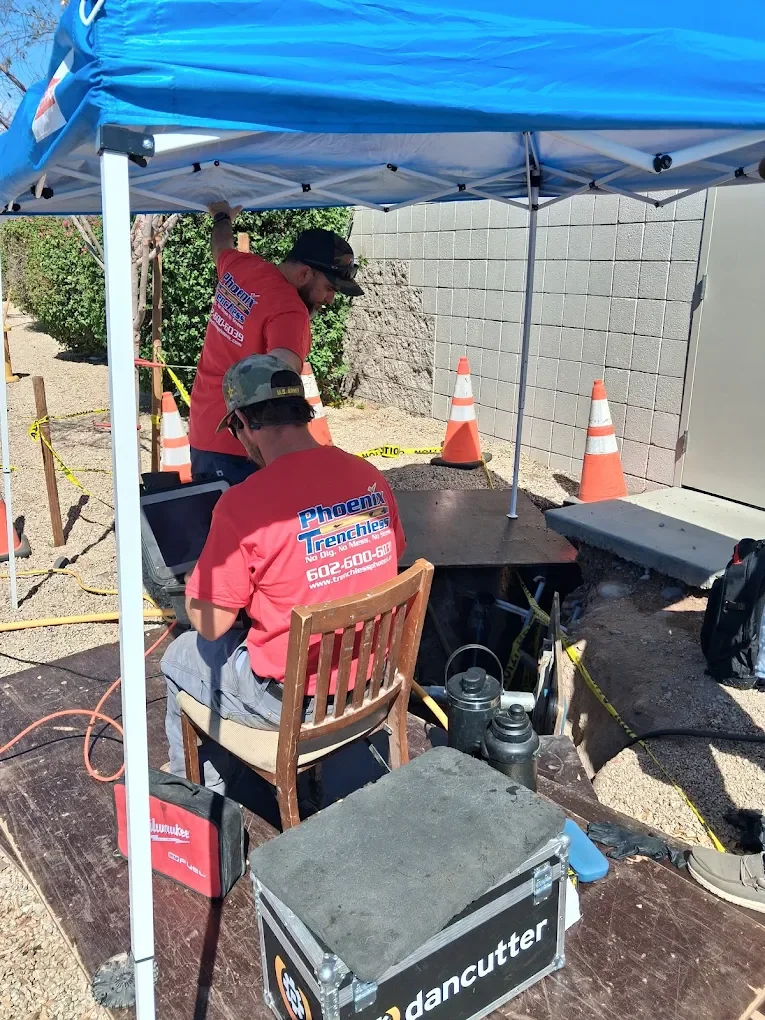
Image of team doing a pipe bursting job
"Do I need relining or replacement?"
It's the most common question homeowners ask after a sewer camera inspection reveals a problem. The answer depends on a single factor: whether your pipe still has structural integrity.
If the pipe is damaged but intact, relining creates a new pipe inside the old one. If the pipe has failed structurally, replacement installs entirely new pipe in its place. Both can be done without digging up your yard. Both involve minimal surface disruption. But they're very different operations addressing very different conditions, and understanding the difference helps you evaluate any recommendation you receive.
What Pipe Relining Is
Pipe relining is a collective term for the trenchless methods that repair a sewer pipe from the inside without removing the original pipe.
The original pipe stays in the ground. It isn't removed. Instead, the repair creates a new structural layer inside it. The most common relining method is CIPP (cured-in-place pipe), but there are several distinct variations.
The four main relining methods:
CIPP Pipe Lining is the most widely used approach. A flexible liner saturated in resin is inserted into the damaged pipe and inflated so it presses against the pipe walls. The resin then cures, hardening into a smooth, seamless new pipe inside the old one. The liner is jointless, corrosion-resistant, and root-resistant, rated for 50+ years of service.
Epoxy Coating and Lining applies a spray or brush-applied epoxy layer to the pipe interior rather than inserting a full liner. Best suited for pipes with early-stage corrosion and minor cracks rather than significant structural damage. Particularly effective for under-slab cast iron drain lines in older Phoenix homes where the corrosion is internal but the pipe hasn't lost structural form.
UV-Cured Pipe Repair is CIPP lining using ultraviolet light to cure the liner instead of heat or ambient temperature. The liner is installed and then a UV light train is pulled through, hardening the resin in minutes rather than hours. Temperature-independent curing makes this particularly reliable during Phoenix summers when heat affects ambient curing methods.
Pull-in-Place Pipe Repair physically pulls the liner into exact position using a cable rather than pushing it with air or water pressure. This gives technicians precise control over liner placement, making it the right method for pipes with significant bends, under-slab direction changes, or targeted spot repairs where only a specific section needs lining.
What Pipe Replacement Means in a Trenchless Context
When people hear "pipe replacement," most picture an open trench across the yard. In Phoenix, that's not the default anymore.
Trenchless replacement most commonly means pipe bursting. A steel bursting head is pulled through the existing pipe using a hydraulic winch, fracturing the old pipe outward into the surrounding soil while simultaneously pulling new HDPE (high-density polyethylene) pipe into place behind it. Two small access excavations are required, one at the house end, one at the street connection. No trench along the full pipe length.
The result is a completely new pipe. The old pipe is gone. The HDPE that replaces it is:
Seamless and jointless along its full length
Corrosion-resistant
Flexible enough to handle Phoenix's monsoon soil movement without fracturing
Rated for 50 to 100 years of service life
Pipe bursting is the right answer when the pipe's condition means relining isn't possible or appropriate. It's also appropriate when a homeowner wants to upsize the pipe, the bursting head can make room for a slightly larger diameter replacement pipe than the original.
How the Camera Determines Which You Need
The camera inspection is the diagnostic step that determines which option is appropriate for your specific pipe. Here's what the camera findings typically indicate:
Relining is appropriate when:
The pipe has cracks, root infiltration at joints, or internal corrosion, but the pipe walls are still structurally present
The pipe is cracked but not shattered or collapsed
Roots have entered the pipe through joints but the joints are still in place
There is scale buildup or surface corrosion but the pipe material retains integrity
The pipe has minor joint separation but is still mostly in position
In all of these situations, the pipe is damaged but intact. A liner can bond to the existing pipe walls and cure into a self-supporting structure inside it.
Replacement is appropriate when:
The pipe has fully collapsed, no structural form remains for a liner to bond to
The pipe is severely deformed, particularly if it's Orangeburg pipe that has flattened under soil pressure
A long section of the pipe has failed structurally, not just at specific joints
The pipe material itself has deteriorated to the point where it can't support a liner during curing
The pipe needs to be re-graded (re-sloped) because it has lost drainage pitch -- this usually requires excavation at specific low points regardless of method
In practice, the most common scenario is clear: a pipe with root infiltration and cracking is a lining candidate. A collapsed Orangeburg lateral is a replacement candidate. The ambiguous cases are in the middle, partial collapse, severe deformation in some sections, structural failure over a significant portion of the run, and these require professional judgment based on what the camera actually shows.
Phoenix-Specific Factors That Affect the Decision
Caliche makes traditional excavation expensive and trenchless the smarter default. Both pipe relining and pipe bursting avoid excavating through caliche, Phoenix's calcium carbonate hardpan layer that sits at exactly the depth where sewer lines are buried. Traditional excavation requires specialized equipment and significantly more labor to break through caliche. When comparing trenchless repair to traditional excavation in Phoenix, the cost gap is wider than in most other parts of the country.
Hard water affects pipe interior condition differently by material. Cast iron drain lines under the slab in older Phoenix homes are particularly vulnerable to hard water corrosion. The rough interior surfaces produced by mineral scale accumulation are exactly what epoxy coating addresses. For these pipes, epoxy coating is often the right choice when the pipe is structurally sound but internally corroded.
Monsoon soil movement affects pipe bursting performance. HDPE pipe installed by pipe bursting is specifically well-suited to Phoenix's monsoon wet-dry soil cycle. HDPE's flexibility allows it to handle soil movement that would crack a rigid pipe, which is one of the reasons it's the preferred replacement pipe material in this market.
Orangeburg pipe in older Phoenix neighborhoods changes the math. Orangeburg, the compressed wood pulp pipe used in post-war Phoenix construction, typically can't be reliably lined because it deforms unevenly. For most Orangeburg, pipe bursting is the correct answer.
Common Scenarios and Which Method Applies
The 1990s Mesa home with slow drains and root infiltration. Camera shows root tendrils at three PVC joints, hard water scale narrowing the pipe diameter. The pipe is structurally sound. CIPP lining is the right answer: it seals the joints, eliminates the root entry points, and restores full flow capacity. One day, no digging through caliche.
The 1960s Sun City home with multiple backed-up drains. Camera shows clay pipe with joint separation and dense root masses throughout. The pipe is damaged but structurally present. CIPP lining is the answer here too, the pipe is still in position, the liner can bond to the clay walls, and the roots need to be removed first by hydrojetting and Dancutter before the liner is installed.
The 1950s Scottsdale home with recurring backups and camera footage showing oval, fibrous pipe. Orangeburg pipe in late-stage deterioration with significant oval deformation. Lining is not reliably appropriate here. Pipe bursting installs new HDPE pipe through two access points, the Orangeburg is fractured outward, and the homeowner gets 50 to 100 years of new pipe life.
The 1975 Tempe rental property with a completely collapsed section. Camera can't pass through a 10-foot section of cast iron that has collapsed. Pipe bursting replaces the full lateral including the collapsed section, accessed through two small excavations. Lining isn't an option when the camera can't reach the damage.
The 2005 Goodyear home with early-stage scale and first-generation root tendrils. Camera shows clean PVC with minor hard water scale and one small root tendril at a single joint. No structural compromise. CIPP lining addresses the root entry point and seals the pipe interior. Or: hydrojetting to clear the tendril and a follow-up inspection in 12 months if the scale isn't severe. Not every camera finding requires immediate repair.
Cost Comparison
Pipe relining is generally less expensive than pipe replacement because it's a less extensive operation. You're not removing the old pipe, you're repairing it from the inside.
The cost difference narrows on jobs where the damage is extensive enough that preparation work (hydrojetting, Dancutter root removal, surface cleaning before lining) adds significant time. On a pipe that requires heavy preparation before it can be lined, the total cost of relining starts to approach the cost of replacement.
In Phoenix specifically, trenchless replacement (pipe bursting) is significantly less expensive than traditional excavation replacement: the caliche factor is real, and avoiding that excavation makes pipe bursting more competitive than it would be in other markets. When comparing pipe bursting to CIPP lining, the cost difference is typically there but narrower than most homeowners expect.
The most expensive option in Phoenix is always traditional excavation replacement. Caliche, surface restoration, and extended labor time push this cost substantially above any trenchless alternative. If a company is quoting you traditional excavation when a trenchless method is applicable, you're paying for a more disruptive, more expensive, and slower repair without a corresponding benefit.
Phoenix Trenchless provides upfront, itemized pricing after the free camera inspection and will beat any written competitor estimate.
The Most Important Thing to Know
The method should follow the diagnosis, not precede it.
A company that recommends relining before looking at the pipe is guessing. A company that recommends replacement before looking is also guessing. The camera inspection is what makes either recommendation defensible.
The right question to ask any company recommending sewer repair isn't "what do I need?" before the camera runs. It's "show me the footage that supports that recommendation" after it does.
If the footage clearly shows a structurally compromised pipe, replacement is the right answer. If it shows an intact pipe with damage at specific points, relining addresses it more efficiently. If it shows minor early-stage issues, maybe neither is needed yet.
The camera doesn't lie. Everything else follows from what it shows.
Frequently Asked Questions
How do I know if my pipe can be lined or needs to be replaced?
The camera inspection determines this. A pipe that is cracked, root-damaged, or corroded but structurally intact is a lining candidate. A pipe that has collapsed, severely deformed, or lost structural form over a significant section needs replacement. Phoenix Trenchless shows you the camera footage and explains which situation applies to your specific pipe before recommending anything.
Is pipe relining a permanent fix?
CIPP liners and UV-cured liners are rated for 50+ years of service life per ASTM F1216 testing standards. The cured liner is jointless, corrosion-resistant, and root-resistant. Every Phoenix Trenchless lining job is backed by our warranty.
Is pipe bursting as disruptive as traditional excavation?
No. Pipe bursting requires two small access excavations, typically about two feet by two feet each, at the ends of the pipe run. There is no continuous trench along the pipe length. Your yard, driveway, landscaping, and pool deck are not involved. This is one of its primary advantages over traditional replacement, particularly in Phoenix where caliche makes excavation expensive and surface restoration adds further cost.
Can a lined pipe ever be re-lined?
Yes. A CIPP liner can be re-lined if it eventually develops problems. The liner is now the pipe, and it can be treated the same way, camera inspected, cleaned, and lined again if needed. This rarely happens within the liner's rated service life, but it's an option if needed.
What happens to the old pipe after pipe bursting?
The old pipe is fractured outward into the surrounding soil and left there. It doesn't need to be removed. The broken pipe material fills into the void it previously occupied, and the new HDPE pipe runs through the center of that space. There is no excavation needed to retrieve the old pipe material.
Does pipe relining work on all pipe materials?
CIPP lining works on clay, cast iron, PVC, concrete, and most other residential pipe materials, as long as the pipe retains structural form. Orangeburg pipe is the primary exception, its deformation and deterioration pattern makes lining unreliable in most cases, and pipe bursting is the typical recommendation for Orangeburg. Epoxy coating has a narrower application range and is most effective on smaller-diameter pipes with internal corrosion.
Can trenchless repair really avoid my pool deck and pavers?
Yes. Both pipe lining and pipe bursting access the sewer line through existing cleanouts or small excavation points at the pipe's entry and exit. Nothing in between is disturbed. This is a major advantage for Phoenix homeowners with custom pool decks, paver courts, and mature desert landscaping over the pipe path.